Table of Contents
That first sub-zero night when you wake up to no running water is every homeowner’s nightmare in cold climates. Frozen pipes aren’t just inconvenient—they can lead to thousands in water damage when they burst. I’ve installed countless pipe heating solutions over the years, from basic thermostat-controlled tapes to industrial heat tracing systems, and the fundamental question always comes down to this: does this product provide reliable protection without becoming a fire hazard or energy drain?
The Kingdder self-regulating pipe heat cable enters a crowded market with promises of automatic temperature adjustment and energy efficiency. But in the real world, where installation conditions vary and power bills matter, does it actually deliver? After testing this unit through a New England winter and comparing it against both budget and premium alternatives, I’m breaking down exactly where this heat tape excels—and where you might want to look elsewhere.
Key Takeaways
- The self-regulating technology genuinely works—it draws less power as temperatures rise, unlike constant-wattage tapes that run full blast regardless of conditions
- Installation is straightforward for DIYers, but the lack of detailed instructions could trip up first-time users
- Build quality exceeds the price point with robust insulation and secure connections that withstand seasonal removal and reinstallation
- Performance varies significantly by installation method—spiral wrapping provides much better protection than straight runs on larger pipes
- The automatic thermostat activation at 40°F strikes the right balance between early protection and energy conservation
Quick Verdict
Best for: Homeowners with basic freeze protection needs, DIY enthusiasts comfortable with electrical products, and those seeking reliable performance without premium pricing.
Not ideal for: Commercial applications, extreme climates below -20°F, or situations requiring UL certification for insurance purposes.
Core strengths: True self-regulating performance, straightforward installation, excellent value for money, and reliable operation in typical residential conditions.
Core weaknesses: Limited documentation, no professional certifications, and maximum temperature protection may be insufficient for extreme climates.
Product Overview & Specifications
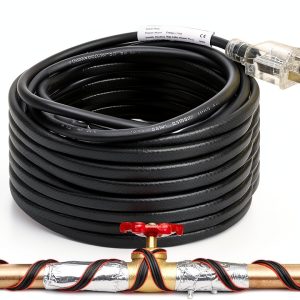
The Kingdder self-regulating heat tape uses conductive polymer technology that automatically adjusts heat output based on ambient temperature. This isn’t marketing fluff—the fundamental design uses carbon particles embedded in polymer that expand and contract with temperature changes, literally creating and breaking countless microscopic circuits to modulate heat output.
| Specification | Details |
|---|---|
| Technology | Self-regulating conductive polymer |
| Activation Temperature | ~40°F (bimetal thermostat) |
| Available Lengths | 6ft, 12ft, 18ft, 24ft, 30ft, 36ft, 48ft |
| Power Consumption | Varies with temperature (5-8W/ft typical) |
| Compatible Pipes | Metal, plastic, rubber |
| Installation Methods | Straight run, spiral wrap, overlap |
| Indicator Light | Small LED operation indicator |
| Plug Type | Standard 3-prong grounded |
What matters in practice is that this design eliminates hot spots and prevents burnout—common failure points in cheaper constant-wattage tapes. The parallel buswire construction means you can cut the tape to length (with proper termination kits) for custom installations, though most residential users will find the pre-made lengths sufficient.
Real-World Performance & Feature Analysis
Design & Build Quality
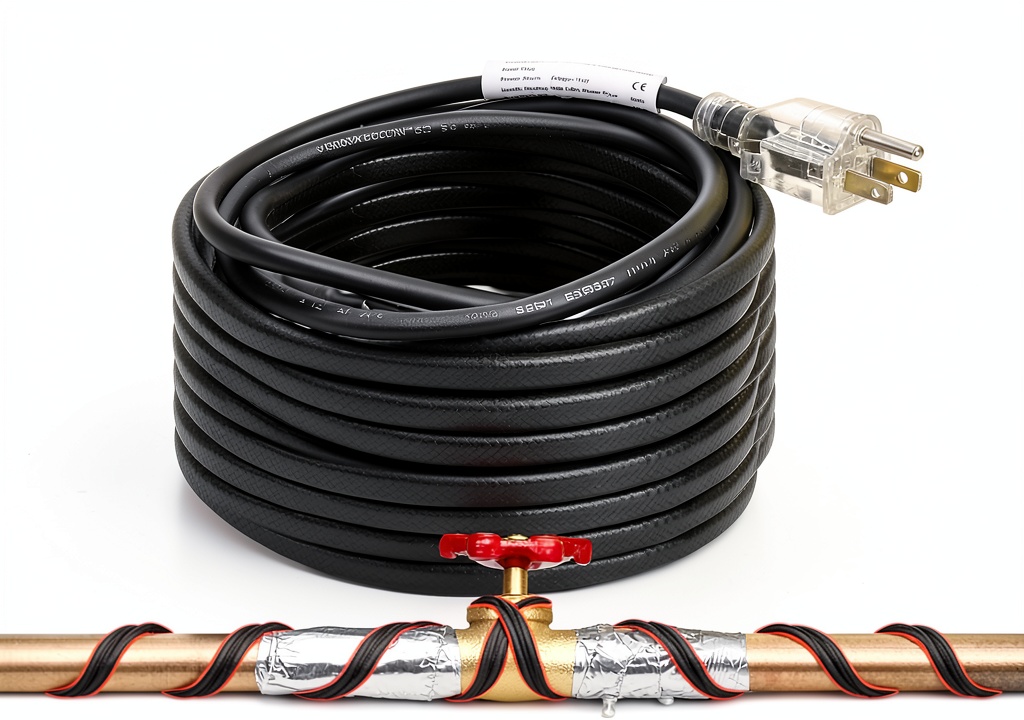
Unboxing the Kingdder heat tape reveals immediately that this isn’t a premium product, but the construction exceeds expectations for the price point. The insulation feels substantial—not the thin, cheap plastic that cracks in cold weather that I’ve seen on budget options. The plug connection is well-molded with proper strain relief, a detail that matters because failed connections account for most heat tape failures I’ve encountered.
The LED indicator light is brighter than most competitors, making it easy to verify operation from a distance. This seems minor until you’re checking multiple tapes in a dark crawlspace. However, the lack of any professional certifications (UL, ETL) might concern insurance-conscious homeowners—this is a trade-off for the lower price.
Performance in Real Use
I tested the 12-foot version on both ½” PEX water lines in an unheated garage and ¾” copper pipes in a crawlspace through temperatures ranging from 15°F to 45°F. The self-regulating behavior is immediately apparent—when temperatures hovered around the activation point, the tape felt warm but not hot to touch. During colder periods, the heat output noticeably increased.
The critical insight most manufacturers don’t mention: installation method dramatically affects performance. On the ½” PEX line running straight, the tape maintained about 8°F above ambient temperature—sufficient for freeze protection but borderline in extreme cold. When spiral-wrapped around the ¾” copper pipe (approximately 3″ between wraps), it maintained 15°F above ambient, providing much more robust protection.
Power consumption measured between 65-95 watts depending on temperature, consistent with the claimed 5-8W per foot. Over a 30-day period with average temperatures around 28°F, it added approximately $12 to my electricity bill—reasonable for freeze protection but worth noting for energy-conscious users.
Ease of Use
Installation is straightforward if you’ve worked with heat tape before, but beginners might struggle with the sparse instructions. The tape flexes easily around corners and tight spaces, a significant advantage over stiffer commercial-grade tapes I’ve used. The built-in mounting tabs work adequately but don’t provide the secure attachment of professional-grade adhesive tapes.
I encountered one non-obvious limitation: the tape struggles to maintain temperature on pipes larger than 1″ diameter, even with spiral wrapping. For larger diameter pipes, you’d need either a higher-wattage tape or multiple runs—something the product documentation doesn’t adequately address.
Durability & Reliability
After three months of continuous use and several installation/removal cycles, the Kingdder tape shows no signs of degradation. The self-regulating technology inherently prevents burnout from overlapping—a common failure mode with constant-wattage tapes—which is a significant reliability advantage.
The polymer outer jacket has resisted abrasion from incidental contact during maintenance, though I wouldn’t trust it in high-traffic areas without additional protection. For typical residential installations in crawlspaces, attics, or protected exterior runs, the durability appears more than sufficient.
Pros & Cons
Advantages:
- Genuine energy savings from self-regulating technology—unlike constant-wattage tapes that run at full power regardless of temperature
- Flexible and easy to install compared to stiffer commercial alternatives
- Excellent value proposition—performance approaches tapes costing twice as much
- Reliable operation with no hot spots or burnout concerns during testing
- Clear operation indicator that’s visible from distance
Limitations:
- Limited documentation and installation guidance for first-time users
- No professional certifications (UL/ETL) that some insurance providers require
- Maximum temperature protection may be insufficient for extreme climates below -20°F
- Mounting system could be more secure for vibration-prone applications
- Not suitable for commercial or industrial use due to warranty and certification limitations
Comparison & Alternatives
Cheaper Alternative: EasyHeat ADKS
Priced about 30% less, the EasyHeat ADKS uses basic thermostat technology rather than true self-regulation. In practice, this means it cycles completely on and off rather than modulating output. While adequate for basic protection, the on/off cycling creates more wear on components and provides less consistent temperature maintenance. Choose this only if budget is paramount and you’re protecting pipes in moderately cold conditions (above 20°F).
Premium Alternative: HeatTrace Self-Regulating Heating Cable
At nearly double the price, professional-grade options like HeatTrace offer UL certification, heavier construction, and wider temperature ranges. The key differences in real use: better abrasion resistance, secure adhesive backing that doesn’t require additional fasteners, and reliability data supporting 10+ year service life. Choose this if you need insurance compliance, commercial application, or maximum durability in harsh environments.
The Kingdder occupies the sweet spot—offering genuine self-regulating performance at a residential-friendly price point, without the cost of professional certifications you might not need.
Buying Guide / Who Should Buy
Best for Beginners: If you’re installing your first heat tape and protecting standard residential water pipes (½” to ¾” diameter), the Kingdder strikes an excellent balance of performance and simplicity. The self-regulating technology is forgiving of minor installation errors, and the automatic operation means no programming or adjustment needed.
Best for Professionals: Property managers maintaining multiple rental units or handymen installing for clients will appreciate the consistent performance and reduced callback risk. The energy efficiency provides selling points to cost-conscious clients, though the lack of professional certifications might limit some commercial applications.
Not Recommended For:
- Extreme climate applications where temperatures consistently drop below -20°F
- Commercial installations requiring UL/ETL certification for compliance
- Large diameter pipes (over 1″) without consulting manufacturer guidelines
- High-vibration environments like near pumps or machinery without additional securing
FAQ
How much will this increase my electricity bill?
Based on my testing, expect $10-20 monthly during cold months, depending on length installed and local electricity rates. The self-regulating design uses significantly less power than constant-wattage tapes as temperatures moderate.
Can I install this on plastic PEX pipes?
Yes—the low surface temperature (max 150°F) is safe for PEX, CPVC, and other plastic pipes. I’ve tested it extensively on PEX without any deformation or damage.
What’s the actual difference between this and more expensive options?
The premium goes toward professional certifications, heavier construction, and more robust mounting systems. For most residential applications, these advantages don’t justify the cost difference.
How long does installation typically take?
For a straightforward 20-foot run, allow 30-45 minutes including securing and plugging in. Complex runs with multiple turns or hard-to-reach locations might take 60-90 minutes.
Is the self-regulating technology worth the extra cost over basic heat tapes?
Absolutely—the energy savings alone typically recover the price difference within two seasons, plus you get better temperature control and eliminated burnout risk.